POTATOES

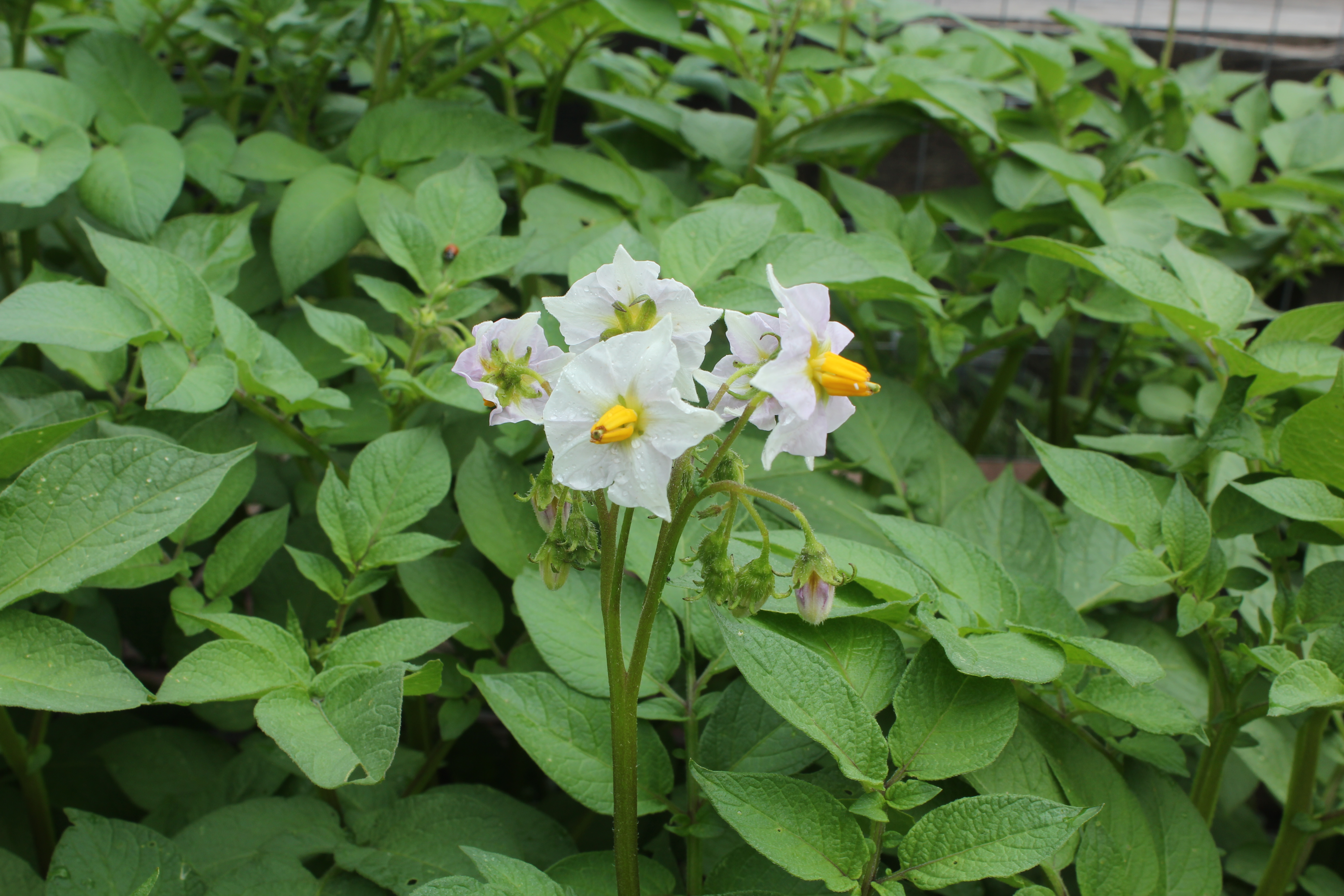
If you need to be reminded of the earth’s ability to create abundance, place a seed potato in the ground in April. By June, when their beguiling flowers begin to blossom, you can reach into the earth and bring up nothing short of buried treasure. The taste of those first homegrown new potatoes, with their delicate feathery skin, is a revelation.
IMG_4741

Potatoes are one of the largest food crops in the world, right up there with wheat, corn, rice, and sugar cane, and they produce one of the highest yields per area planted of all food crops. They are low in calories, have no fat, sodium, or cholesterol, and are full of potassium, Vitamin C, Vitamin B6, fiber, and iron. And for all that they have still ridden the wave of fashion throughout our history with them. Yet as historian William H. McNeill, argues in his 1999 article, How the Potato Changed the World’s History, the humble potato created at least two empires and changed the world in a number of ways.

Potatoes originated in the Andes Mountains of Peru, the longest continental mountain range in the world, a whopping 4,500 mile spine of seismic activity and extreme temperature fluctuations that stretches down the western coast of South America.  Wild potatoes are full of toxins to protect them from predators both microscopic and macroscopic, but the ancient Incas (Empire #1) cultivated them in this much less than hospitable place, breeding them to be less-toxic and developing thousands of varieties for the multitudes of growing conditions with which they were faced. The International Potato Center in Peru contains almost 5,000 varieties! 

Spanish conquistadors arrived in the region in 1532 and following the natives lead, began to eat the strange food, taking some with them when they departed. By 1570 the potato had arrived in Spain, and while a few farmers began to grow them, most were consumed by livestock. It took quite a while, but slowly they began to spread to the rest of Europe.

By 1596 the potato had at least been given its name, Solanum tuberosum, by the Swiss naturalist Gaspard Bauhin.  Still, early reception to this new food was unenthusiastic. It was feared for its resemblance to other plants in the nightshade family, thought to cause leprosy, reviled by believers because it wasn’t mentioned in the Bible, and generally ignored because it was considered ugly and tasteless and because it came from a heathen continent (ours) – it was a food only fit for animals.

Frederick the Great of Prussia famously tricked his people into eating potatoes during a famine there in 1744 by placing guards around his potato field. The peasantry deduced that whatever was worth guarding in there was worth eating, and when the fields were (intentionally) unprotected, they sneaked in, stole the plants, and put them in their own gardens.

In France, the potato’s PR hero was Antoine-Augustin Parmentier. As an army pharmacist during the Seven Years’ War (1756-63) he was imprisoned five times, subsisting on little but potatoes. After the war he became a nutritional chemist and devoted his life to championing the potato. Due to his efforts, the potato was finally declared edible by the Paris Faculty of Medicine in 1772. So if you see a recipe with the word Parmentier in the title, you can rest assured that the dish features potatoes. The story goes that when Parmentier was on his quest to raise potato awareness he had a big society party featuring a variety of dishes made with potatoes. He presented Marie Antoinette with a bouquet of the flowers which she wore in her hair, causing a fashion moment. Thomas Jefferson, who was also a guest at the party, reportedly served potatoes “in the french manner” at a White House dinner upon his return. 

This reluctance to embrace the potato is incredibly ironic considering that poverty and famine were commonplace throughout Europe before the shift to potato cultivation, especially in the countryside. Then, wherever it traveled, populations exploded. France had hovered on the brink of starvation, experiencing a nationwide famine approximately once a decade from 1500-1800, before the potato arrived. In Ireland between 1780-1841 the population doubled to 8 million, and this without any change in industry or agriculture, beyond adoption of the potato. According to conservative estimates, the introduction of the potato was responsible for a quarter of the growth in Old World population and urbanization between 1700 and 1900. (Empire #2.) 

Unfortunately, by the early 1840’s many of Europe’s poor, especially those in Ireland, were existing on nothing but potatoes, so when that monoculture was plagued by the pathogen Phytophthora infestans the results were devastating. An estimated 1,000,000 people in Ireland died during The Irish Potato Famine ( 1845-52) and twice that fled the country, many of them to the United States. 

Another potato pest gave rise to the modern pesticide industry. Leptinotarsa decemlineata, the Colorado potato beetle, was first discovered in the United States in the 1824. It is believed to have come from Mexico where it fed on the potato relative, buffalo bur (Solanum rostratum). By the 1840’s it had arrived in the United States where it discovered and laid to waste acre after acre of domestic potatoes. Desperate farmers tried everything in their arsenal to destroy them, but it wasn’t until one hopeless farmer threw some old green paint on his plants that anything worked. That paint, Paris green, turned out to have been made with arsenic. Various arsenic compounds worked for a while until the beetles developed resistance to them. Enterprising chemists began to try any number of chemical brews, which all worked, for a while. By the end of WWII, the answer was DDT, that lasted about seven years. After that it was deildrin. You don’t even want to know about dieldrin.

Now do you want to grow your own delicious organic potatoes? I sure do.

Luckily that’s an easy thing to do. As Deborah Madison so nicely puts it in her masterwork, Vegetable Literacy (2013) “potatoes are obliging in the garden,” as anyone who has ever thrown one on a compost pile can attest. They want to grow.

Plan on planting them 2-3 weeks before the last frost date in your area. The last frost date I use for my area is April 20th. (That doesn’t mean it’s not going to snow in May.) We planted ours on March 30th.

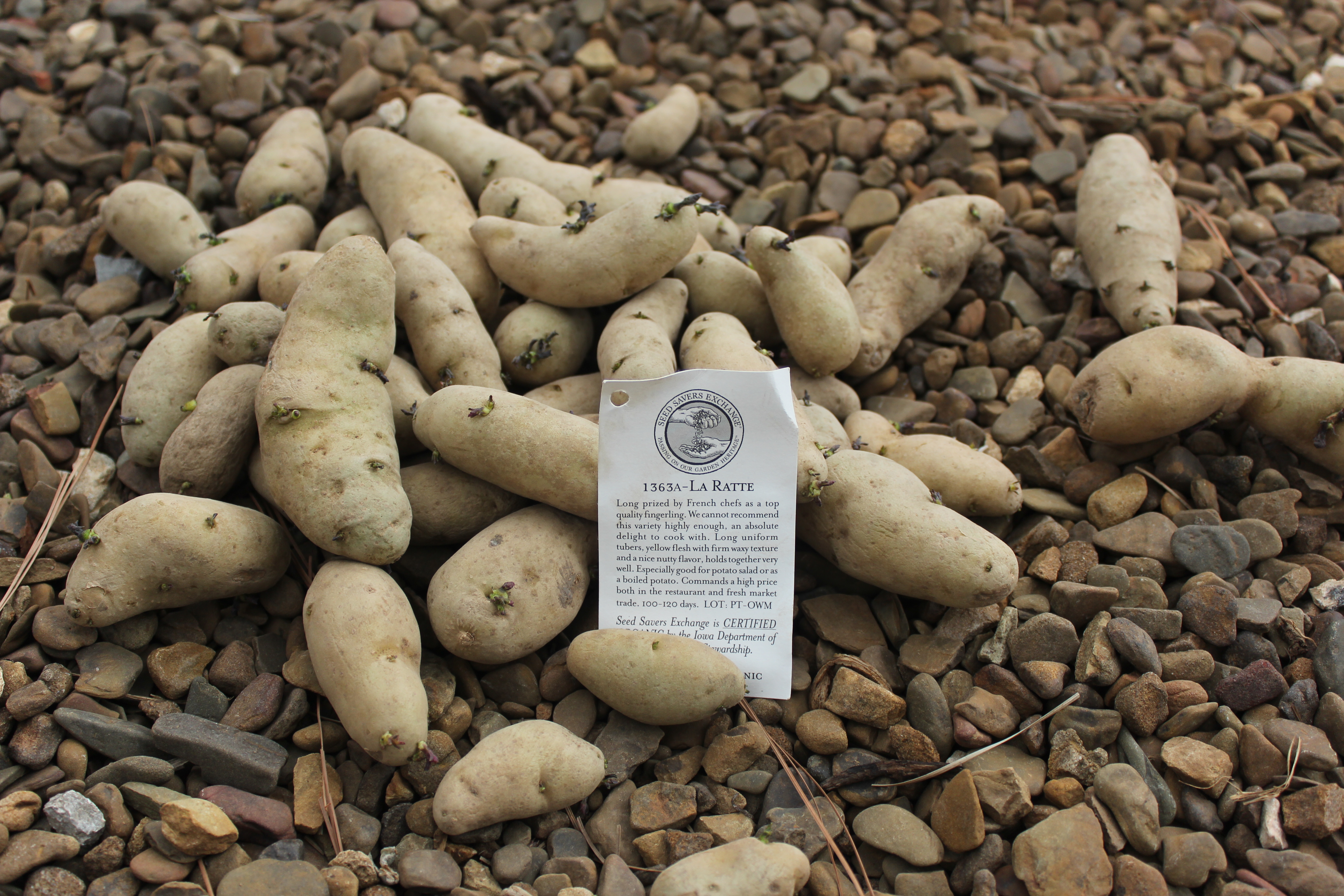
Unlike most garden crops, potatoes are not grown from seed. Instead they are grown vegetatively from small potatoes called seed potatoes.
IMG_4504

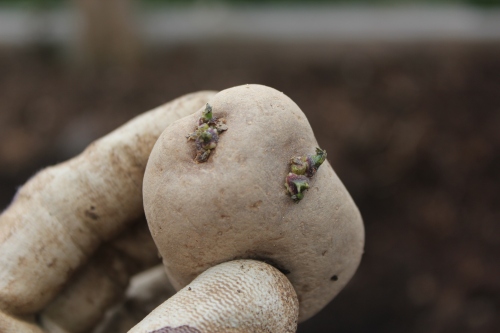
Seed potatoes can be planted whole or cut into pieces, as long as each piece has an eye. I plant mine whole because I have more potatoes than I have room, but if you do cut yours, use a sharp knife and allow them to callus overnight. Potatoes are heavy feeders, so I worked plenty of compost into my soil while I was loosening the soil in preparation for planting.
IMG_4499

Traditionally potatoes are planted in a trench about 6″ deep and they are placed 12-16″ apart. We made two trenches about about 18″ apart. Further apart would be better, but our garden is on the small size, so we plant pretty intensively.

IMG_4483

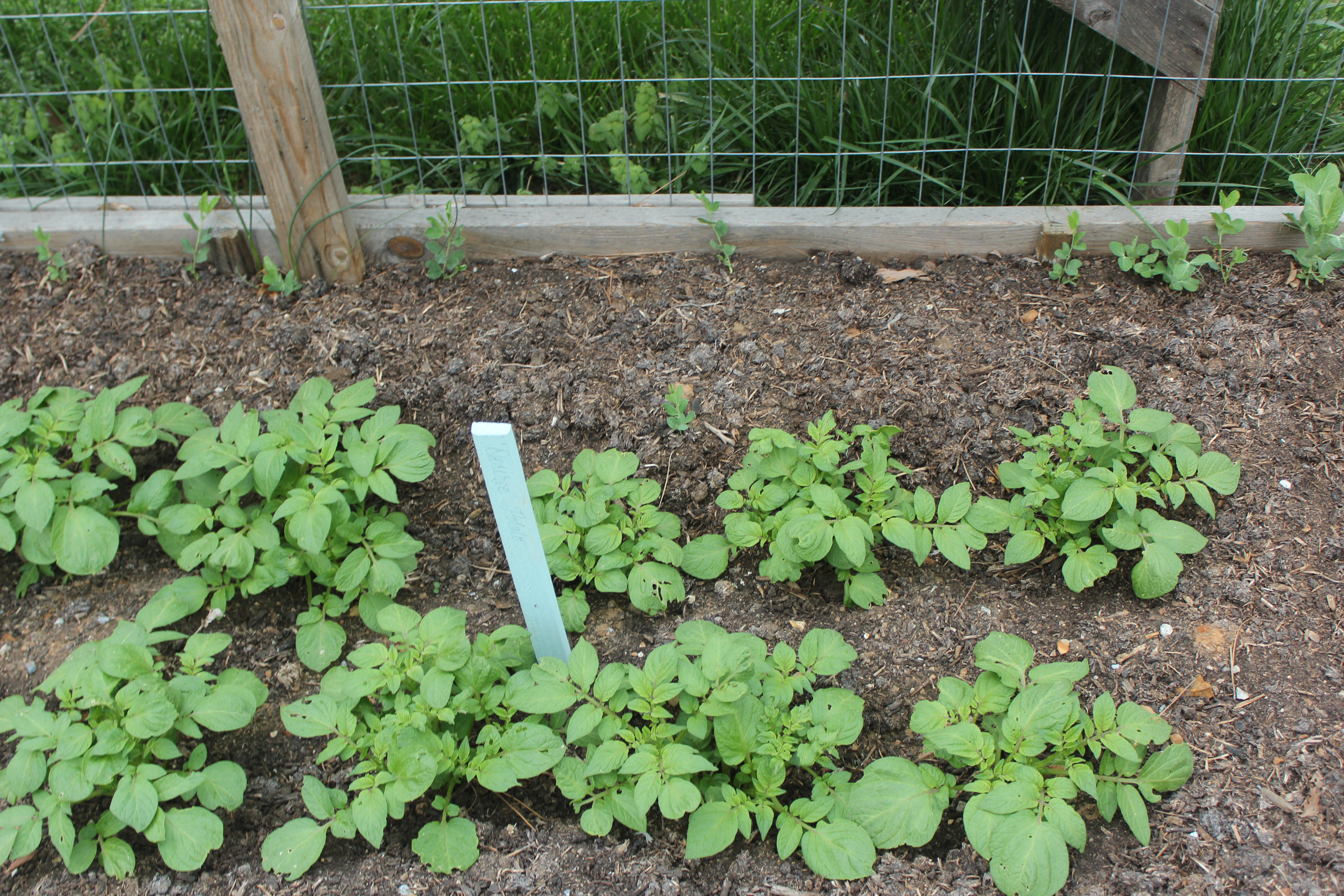
Each trench is then re-filled with soil. Soon, from each of those eyes a sprout will develop. Miraculously, that sprout will find the sun and begin to make leaves above ground.
IMG_4662

Then, from the stem of that sprout will come stolons, the ends of which will swell to create potatoes. For this reason it is important to do what is called hilling up. When the plants are about 4-6″ tall, cover then with loose soil almost to the top of the leaves. Plan to do this again about three weeks later. This year I’m going to try my second hilling with pine straw. I’m also going to try to grow some in a container, which is a great option if you don’t have an in-ground garden. I’m going to put about 6″ of soil in a big (30g) plastic nursery pot, I’ll space about 5 potatoes in it and cover them with 4-6″ of soil. As they grow, I’ll continue to hill them up until the soil in the container is 18-24″ deep.

Seed potatoes can be kept back from the previous year’s crop, or ordered fresh every year.  I ordered mine from Seed Savers Exchange (http://www.seedsavers.org).

Because they are grown vegetatively, each potato is a clone of its seed potato, which means that diseases are passed down along with other genetic characteristics. Therefore, the oldest heirloom varieties that we grow today were developed after the blight, around the 1850’s, from Mexican or South American stock.

This year I’m growing La Ratte again, it’s a French fingerling with a delicious nutty taste. I grew them last year because Seed Savers “couldn’t recommend them highly enough.” Roasted whole with olive oil and sea salt, we enthusiastically concur. We didn’t save a single one to store or use as seed, but I’ll try harder this year. I’m also trying Yellow Finn, whose “exceptional buttery sweet flavor sets it apart from all other potatoes.” I’ll let you know.

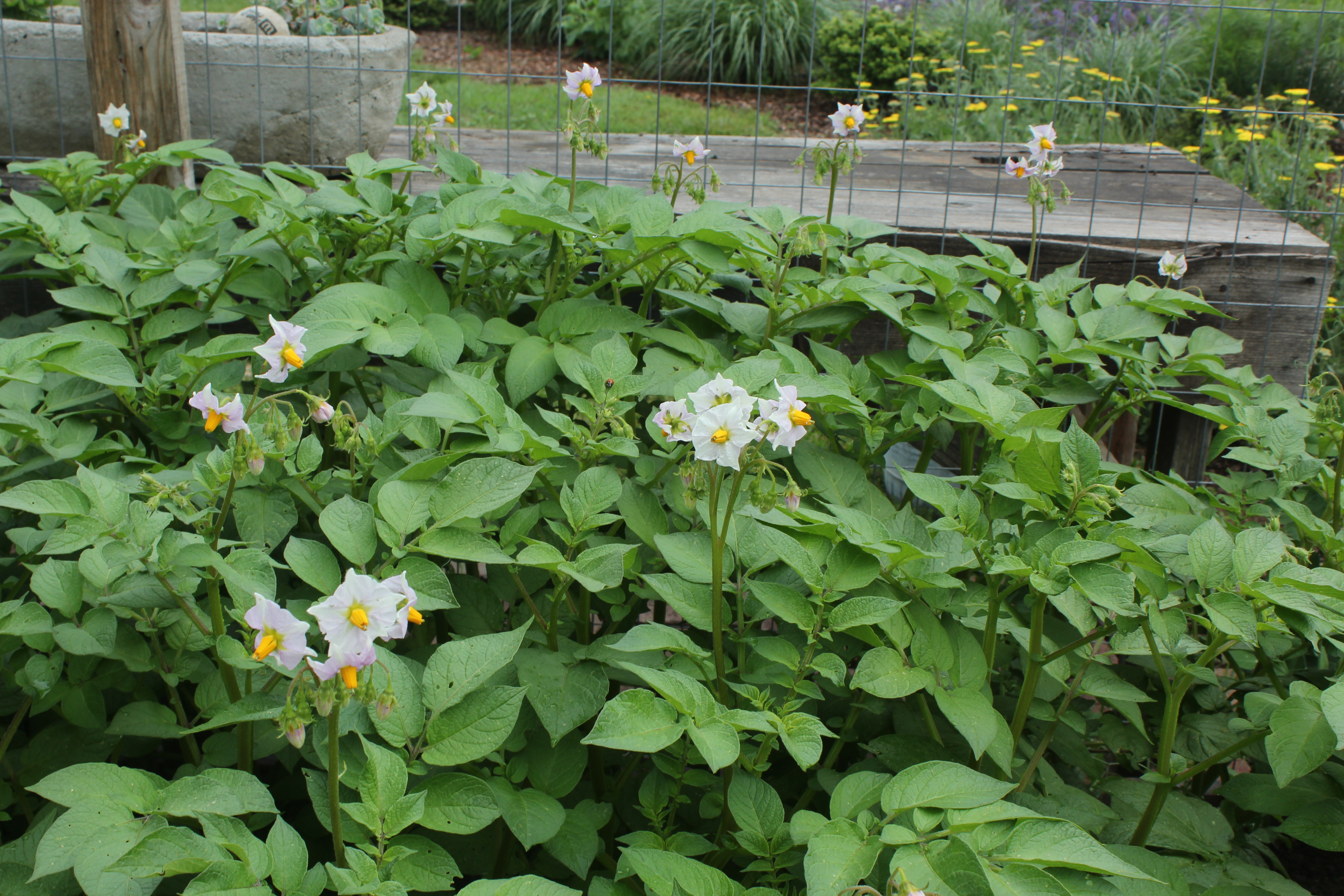
In about 60 days, those beautiful flowers will appear, (although sometimes they don’t and the plants still produce potatoes).
IMG_4742

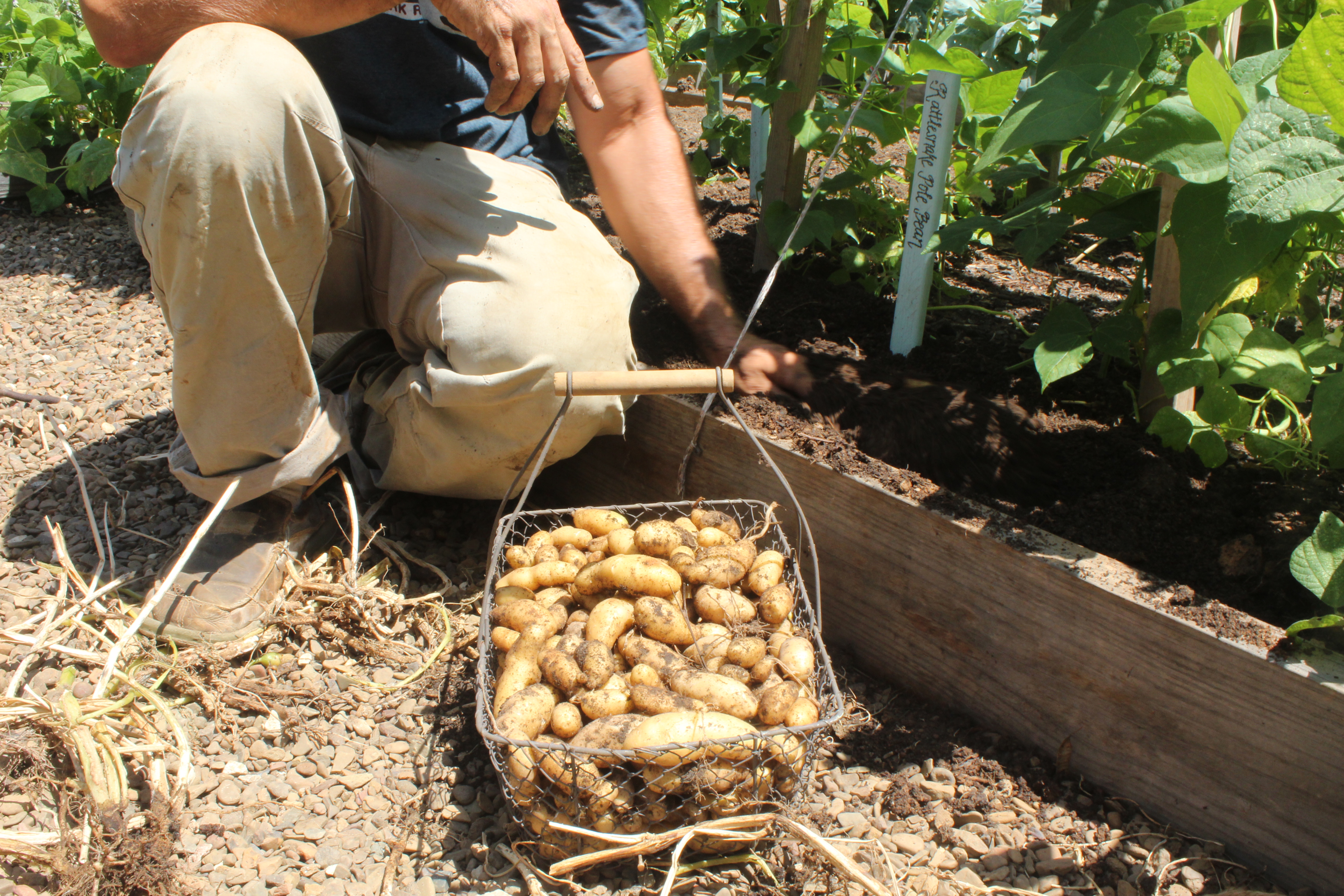
 Tuck one behind your ear à la Marie Antoinette, then patiently wait for a couple of weeks.  When you can’t stand it any longer, gently dig into the soil around the stem, where hopefully you’ll find your buried treasure. These are what are called new potatoes and they are an early summer luxury.
IMG_5159

You can pull up the whole plant, eat them all immediately, and grow something else there, or you could continue to harvest throughout the summer. Be warned, they take up a lot of space.

IMG_4949

That’s a path.

IMG_4788

Here’s the potato corner June 1, 2014. Sorry beans.

By fall, the foliage will begin to die back. You can leave the potatoes in the ground for several weeks, but make sure you harvest them before any killing frost, or if the weather is warm and wet and could signal the potatoes to start sprouting. I don’t have the greatest conditions for storing potatoes, which is just as well, because once I start harvesting them I really can’t stop.

For a great article comparing different potato planting methods, check out (http://www.rodalesorganiclife.com/garden/7-ways-plant-potatoes).
ONIONS

Waxing philosophic about onions is a bit like writing poems to your feet. Yet where would most of us be without those? They are the foundation upon which everything else stands. They provide us with balance, structure, and support. When your dogs are barking, nothing else matters. Onions (Allium cepa) are much the same. Among the first vegetables ever cultivated, remains of them have been found that date back to 5,000 BC. It’s believed that they originated in Asia, but it’s also possible they grew wild on every continent.

If space is a consideration in your garden, onions might not be at the top of your grow-your-own wish list. After all being the most widely eaten vegetable in the world, they are available year round at any grocery store or farmer’s market. Still, I love onions and I can’t imagine cooking without them, so when I ran across onion seedlings at a nursery last March I thought, why not? And I’ll tell you, the experience of going out to my garden and harvesting an onion moments before I needed it was so satisfying that I’m doing it again this year. Homegrown onions taste better and can be harvested at any stage of their growth – as spring onions at their immature stage, throughout the summer as their bulbs begin to develop, and, if cured and stored properly, throughout the winter. Onions are with us full circle.

Nutritionally, onions are low-calorie powerhouses. They are high in vitamin C, dietary fiber, and folic acid and contain calcium, iron, phosphorus, potassium, manganese, and magnesium. They also contain the flavonoid quercetin, an anti-oxidant that may help in the prevention of heart disease and many cancers. They are anti-inflammatory and anti-bacterial. Eating them regularly increases bone density, strengthens connective tissue, and balances blood sugar.

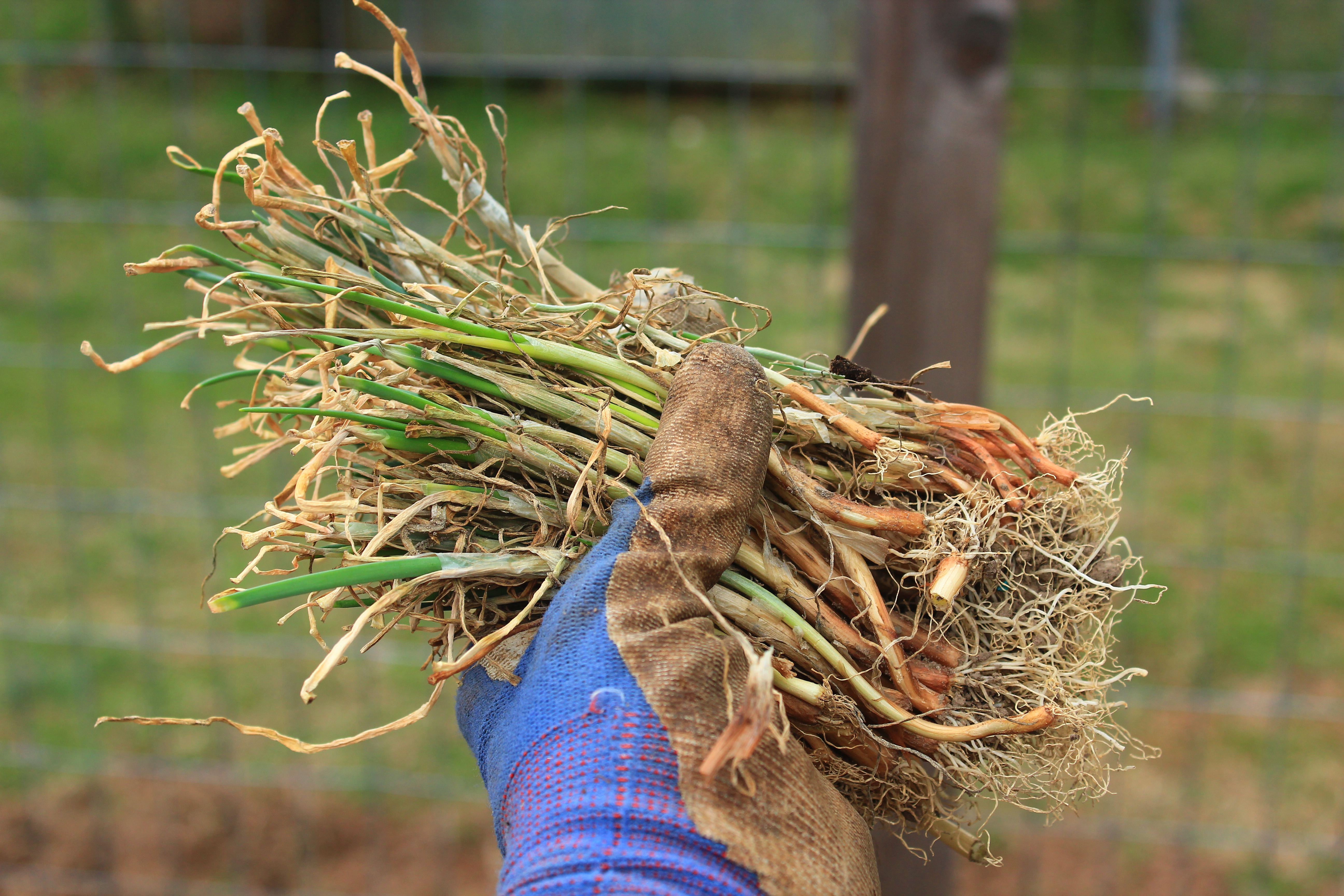
Most onions are grown from seedlings or sets. Seedlings are tiny onion plants, about 5″ long, usually tied in a bundle of 50 or more. They look like baby scallions. Sets are tiny, immature onion bulbs, like cocktail onions. I have yet to try growing onions from seeds, but perhaps one of these days I’ll get ambitious. There are certainly more varieties of seed available than there are seedlings or sets, but growing from seed takes more space and time and is more of a challenge. I’ve been happy with seedlings.

IMG_7118

Onions are photo-periodic, which means they require a certain number of daylight hours before they begin to form bulbs. There are three categories of onions. Long-day onions will not begin forming bulbs until the days are 14-16 hours long. These do better in the north (in North America) where the days are longer. Short day onions, which do better in the south, need 10-12 hours of daylight to bulb. Intermediate-day onions do well when daylight reaches 12-14 hours.

It also helps to know your latitude. Northwest Arkansas, where I’m growing, is at 36º N, so the best onions for me are intermediate-day onions which work well from 32-42º N. Luckily, the nursery where I got my seedlings knows this and orders onions that work best in this area. The varieties I’m growing are Super Star, the only white onion to win AAS distinction, Candy, which works almost everywhere in the United States, and Red Candy, a beautiful, sweet, mild red onion.

I learned a lot for this post from Dixondale Farms (http://www.dixondalefarms.com). They have been growing onions since the early 1900’s and supply onion plants to the entire country. From them I learned that the perfect onion has 13 rings. This also means that it has 13 leaves, since each ring is a modified leaf. Don’t worry, a smaller onion is not inferior in taste, it’s merely smaller. The more leaves an onion grows before the days get long enough to trigger it to begin forming a bulb, the bigger it will be.

I planted my onion seedlings on March 17th. First I made sure the soil was fairly pulverized, as Barbara Damrosch advises in her The Garden Primer, and then I made three long shallow furrows down the length of the bed. I sprinkled a balanced fertilizer into each furrow.

The fertilizer I used is Nitron’s (http://www.gardeniq.com) Nature Meal Vegetable Fertilizer (4-8-4). Those numbers correspond to the ratio of nitrogen, phosphorus, and potassium. This one is made from feather meal, bone meal, sulfate of potash, and alfalfa meal. I purchased it at Ozark Natural Foods (http://www.onf.coop).

IMG_7122

I spaced the seedlings approximately 4-6″ apart and used a hand cultivator to gently bring in soil around them, incorporating the fertilizer, until the row was planted. Then I firmed the soil around each little plant all the way down the row and watered them gently. I’ll keep an eye out for weeds because shallow rooted onions don’t like the competition and weeds can rob them of needed nutrition. I’ll also keep an eye on the weather and if it looks like we’re going to get another freeze, I’ll water them well, mulch them, and cover them with burlap for protection. I’ll mulch them anyway when they get about a foot tall to maintain soil moisture and keep down weeds. When they get about as big around as my finger, I can start to harvest some as spring onions, which will give the others more room to develop.

IMG_4737

Another nice thing about growing onions is you can see what they’re up to. When the bulbs begin to form, their shoulders start to emerge from the ground, unlike, say, potatoes, where you’re left to wonder what they’re doing under there. Then in late summer, when the bulbs are done forming, the leaves begin to brown and fall over.

IMG_5273

Now you know it’s time to cure them for storage. Gently, (they may seem sturdy, but it’s important to be gentle with them as any bruised places will rot over time) remove them from the soil, and allow them to dry for a couple of days. This can be done in the garden, or if rain threatens, in a warm, dry, place. Next, find a dry place out of the direct sun with good air circulation and let them dry a good three weeks or so. You can then cut off the tops and store them in mesh bags, or even panty hose with a knot between each bulb, or you can braid their leaves together and hang them. Barbara Damrosch advises weaving in a strong piece of twine to help keep it all together. Keep them cool, dry and well-ventilated, and use any compromised onions and those with thick necks first. It should be noted that sweeter onions do not store as long as the more pungent varieties.

In the kitchen, onions are incredibly versatile. From France’s mirepoix, to Italy’s battuto, Spain’s sofrito, or cajun cooking’s Holy Trinity they are the humble beginning from which all else stems. They can be eaten raw in salads or sandwiches. They can be pickled. They can be stuffed and baked, sauteed slowly and pureed into a classic soubise, or allowed to release their sugars until they carmelize. They are essential in stocks, soups, stews, and casseroles. And is there anything more sublime than French onion soup?

IMG_6564

Every time I grill I cut one in quarters from the top down, keeping it intact at the base, then I wrap it in foil with olive oil or butter, or maybe some blue cheese and let it cook until the outside is almost burned, and the inside is meltingly sweet and mild. So good alone or with grilled meat. And what about onion rings? Or sausages with peppers and onions? Get outta here!

One of my favorite restaurant jobs was at a now-shuttered restaurant in Manhattan called Elettaria. It was a romantic, lamplit, cozy place with tiki-themed cocktails (27 rums on the menu!) and an open kitchen. Our chef, Akhtar, was of Indian origin and his food was laced with exotic Indian spices. I worked there from the day it opened until the sad sad day that it closed. Oh, the stories I could tell. I loved to watch Raphy scrupulously sharpen his knife and prepare the onions for the crab meat resala which was served with a turmeric laced soubise, (I’d also be hoping that he was making family meal). There was such zen precision to those perfect thin slices. I’ve thought about how an onion is cut ever since. Sliced, diced, minced, chopped, grated, it matters. Take your time with your onions. Prepping them and cooking them. If that prep makes you weep, make sure your knife is nice and sharp, or try refrigerating your onions before you slice them.

As Nigel Slater says in his gorgeous, passionate, wonderful Tender (2009), one of my all time favorite cookbooks, “Get the onion part of a dish right and you are halfway towards a good supper. Get them wrong and no amount of cooking and clever stunts can quite put matters to rights.” Amen to that, Nigel.

______________

In other news:

Everything survived the crazy hail storm on March 25th.

Beet, chard, kale, lettuce, arugula, broccoli raab, cavolo broccolo spiragriello, collard greens, spinach, and radiccio seeds have all been planted out. Pea and radishes seedlings are just starting to emerge and the fava beans are doing great. I planted some flat-leaf parsley plants in the leaf bed because I love it so and it’s challenging to grow from seed.

The perennial bed is slowly coming to life and the camassia and allium bulbs I planted last November have surfaced. I’ll take you on a tour of all that soon.

Asparagus spears are thrusting through the pine straw mulch! Too bad I can’t eat any until next year.

Seed potatoes from Seed Savers arrived in the mail and I’ll be planting them forthwith and telling you all about it next week.

I also MUST start tomato and pepper seeds. I should have started eggplants a month ago and I didn’t and that just has to be okay. You can’t win them all.

I hope everyone and their gardens are doing great, that you’re all happy, healthy, well-rested, and looking forward to your spring!

Namaste!

PEAS

IMG_4743

Peas are enchanting. And reason enough to have a garden. Their delicate nature, the fact that they start to lose their natural sugars once they’re picked, and their small window of availability makes growing your own a great way to insure that you don’t miss out on this early, rare treat of the garden year. And such lovely short term guests they are. So dainty and welcome with their pretty paired wing-like leaves, their sweet pale flowers, and their curlique tendrils. Those tendrils kill me. The way they seek and find and twine and draw themselves ever upwards. Emblems of curiosity and vitality. Like hope. In cursive. 

Circumnutation is the term used to describe this motion. It was coined by Darwin himself who was also fascinated by tendrils.

Peas, (Pisum sativum – sativum is Latin for cultivated) are one of the earliest domesticated plants (8000 BCE!). They also have the broadest range geographically and climactically of any legume, although they weren’t eaten fresh until the 16th century. These days a lot of fresh peas don’t even make it out of the garden, especially if my niece is around. (If you manage to end up with a glut of peas, please let me know.)

And because they express their genes consistently, Gregor Mendel used them in his experiments between 1856 – 1863 which laid the foundation for modern genetics. So, thanks again peas. 

The science of phenology tells us that the time to plant your peas is when the forsythia blooms. According to the Aldo Leopold Foundation (http://www.aldoleopold.org/Programs/phenology.shtml), “Phenology is a segment of ecology focusing on the study of periodic plant and animal life-cycle events that are influenced by climate and seasonal change in the environment.” Aldo kept records of the first occurrences of everything from blooms to migrating bird arrivals on his land in Wisconsin from 1935-1948 and these are chronicled in his seminal conservation treatise A Sand County Almanac (1949). His daughter Nina took up the work and kept detailed records of her own from 1976 until her death in 2011. These records, spanning 70 years, show that the first occurrences of certain songbirds and plant blooms are now up to three weeks earlier than when Aldo first began his observations. These records, and many more like them, kept by observant, organized, and generous souls, have important implications for the study of climate change, as well as for farmers, gardeners, and nature lovers. It’s fascinating, crucial stuff. Looking to nature for cues reminds me to be observant, as well as grateful, for the deep connection we share with every living thing. Turn,turn,turn.

IMG_4744

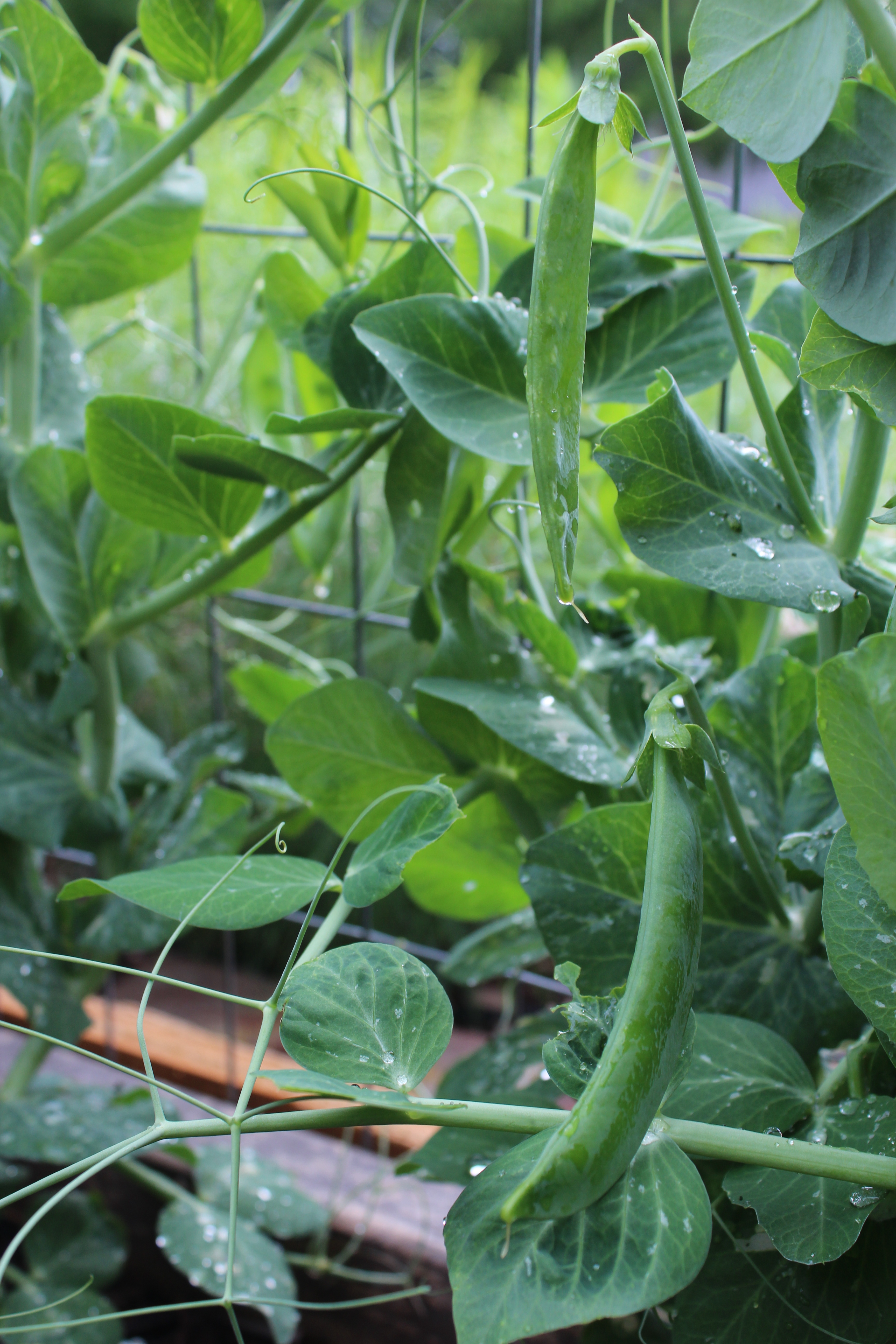
These days we recognize three kinds of peas. English, or shelling peas, which are the familiar peas in a pod type from which the peas are removed and eaten. Snow peas, (P.sativum var. saccharatum), which are flat and eaten whole and are sometimes called Chinese peas because they are so often found in stir frys. And snap peas (P. sativum var. macrocarpon), which are a relatively recent cross of the two. Snap peas have sweet edible pods with fat round peas visible inside. These latter two are sometimes called mangetouts, or French for “eat all.”

This year I’m trying two kinds of English peas. Lincoln is a high-yielding, heat-tolerant, delicious pea that was introduced in 1908. I saved seeds last year, so I’m hopeful that these will perpetuate themselves. I’m also trying Iona Petit Pois which are tiny French peas, about half the size of regular shelling peas and are reported to be an exceptional treat. I can’t wait to find out. I’m also trying Sugar snap peas for the first time. This variety was an AAS winner in 1979, with 5-6′ vines and exceptionally sweet pods. Snap peas are reportedly more heat tolerant than English peas, so hopefully that will extend my season of peas.

All peas are incredibly nutritious. They are good sources of protein and fiber while being low in calories. They have high concentration of vitamins A, C, K, and folic acid, as well as phytonutrients, anti-oxidants, and minerals such as calcium, iron, copper, zinc, manganese, and phosphorus. The edible pod types are even lower in calories, but hold more vitamins and minerals than the shellers. The shoots, which include the leaves, stems, flowers, and tendrils are also edible and nutritious and can be lightly steamed or sautéed, or eaten raw in salads. Shelled peas can be eaten raw or tossed into rapidly boiling water for a mere three minutes. If you manage to resist eating them, they can be added to salads or risotto. Or you could make a lovely spring soup.

Well, the forsythia is blooming so it’s time to plant some peas! I planted mine close together against my garden fence, in two rows about 2″ apart and 1″ deep. I had planned to make some supports perpendicular to the fence, but David got worried about shade, so we’re just going to let them climb up the fence and give them something more to climb on later if they need it. Pea vines are very delicate, so I’m going to leave them alone to do their thing. The favas are already planted in front of them, so I’ll have no reason to disturb their ascent. I just hope they appreciate all this rain and don’t decide to rot!

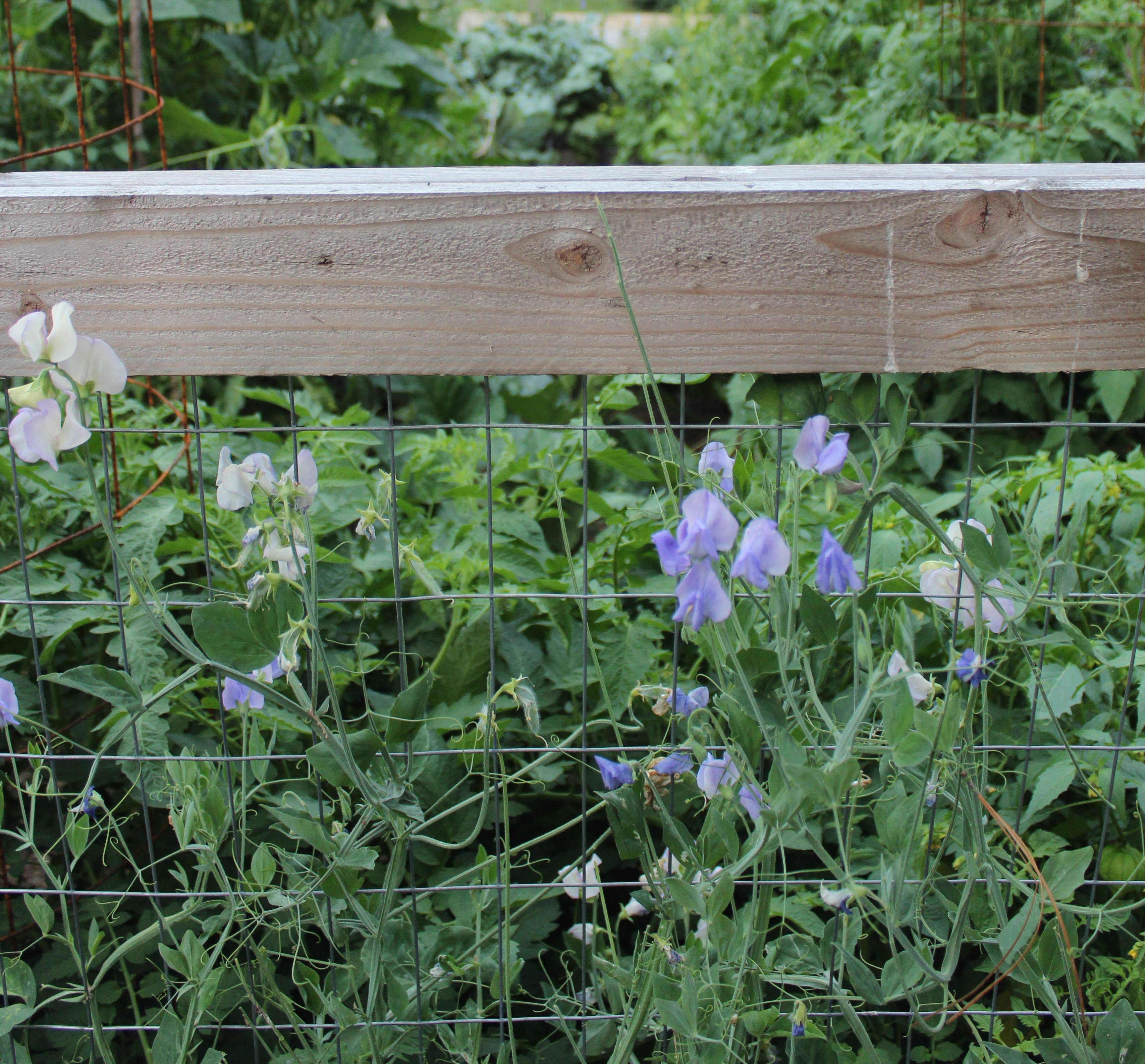
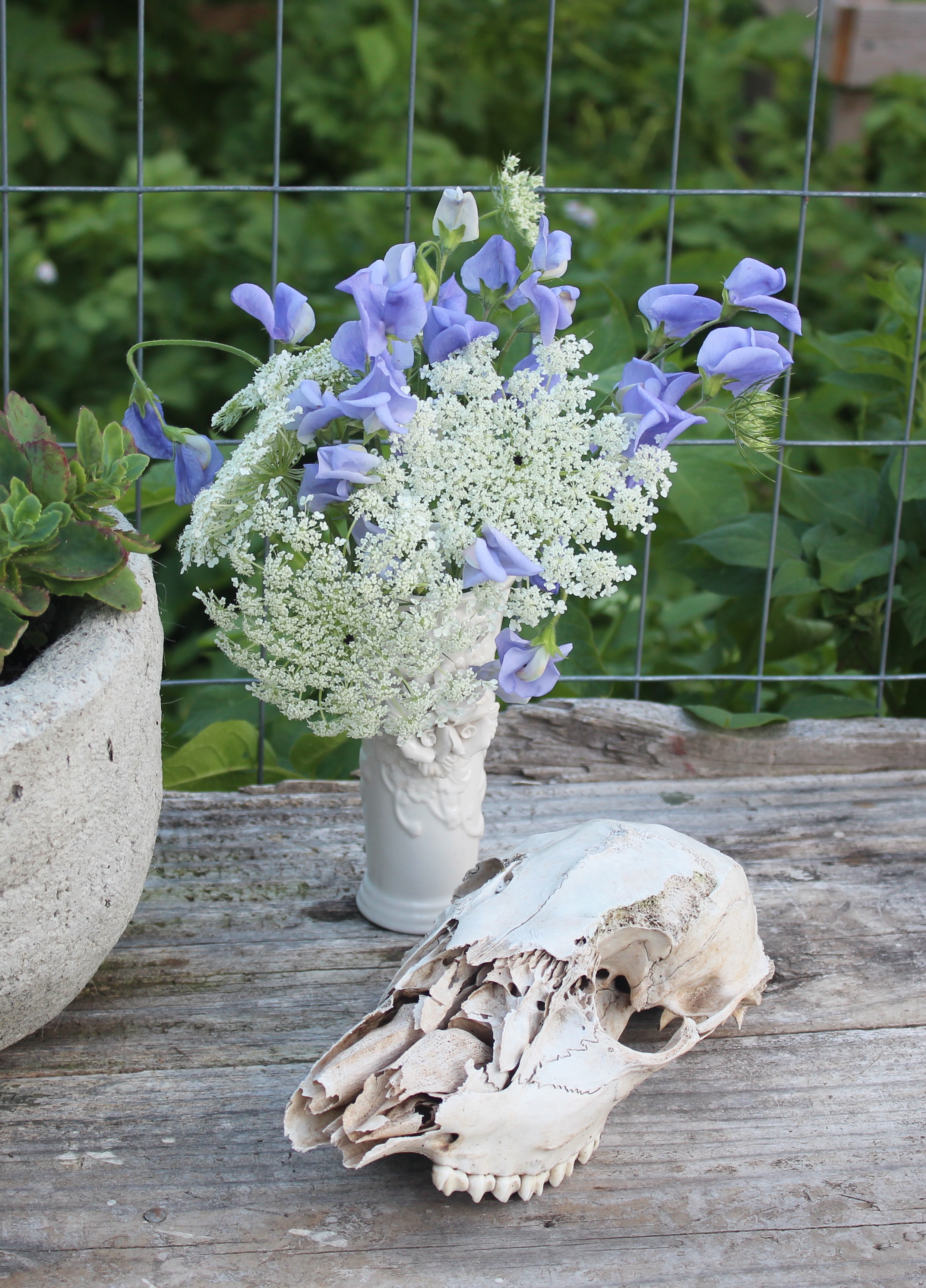
I also planted some sweet peas. Flora Norton are clear blue sweet peas with an intoxicating fragrance. I saved these from last year and planted them all along the garden fence behind the perennial beds. They make a delightful cut flower too.

IMG_5043

IMG_4878

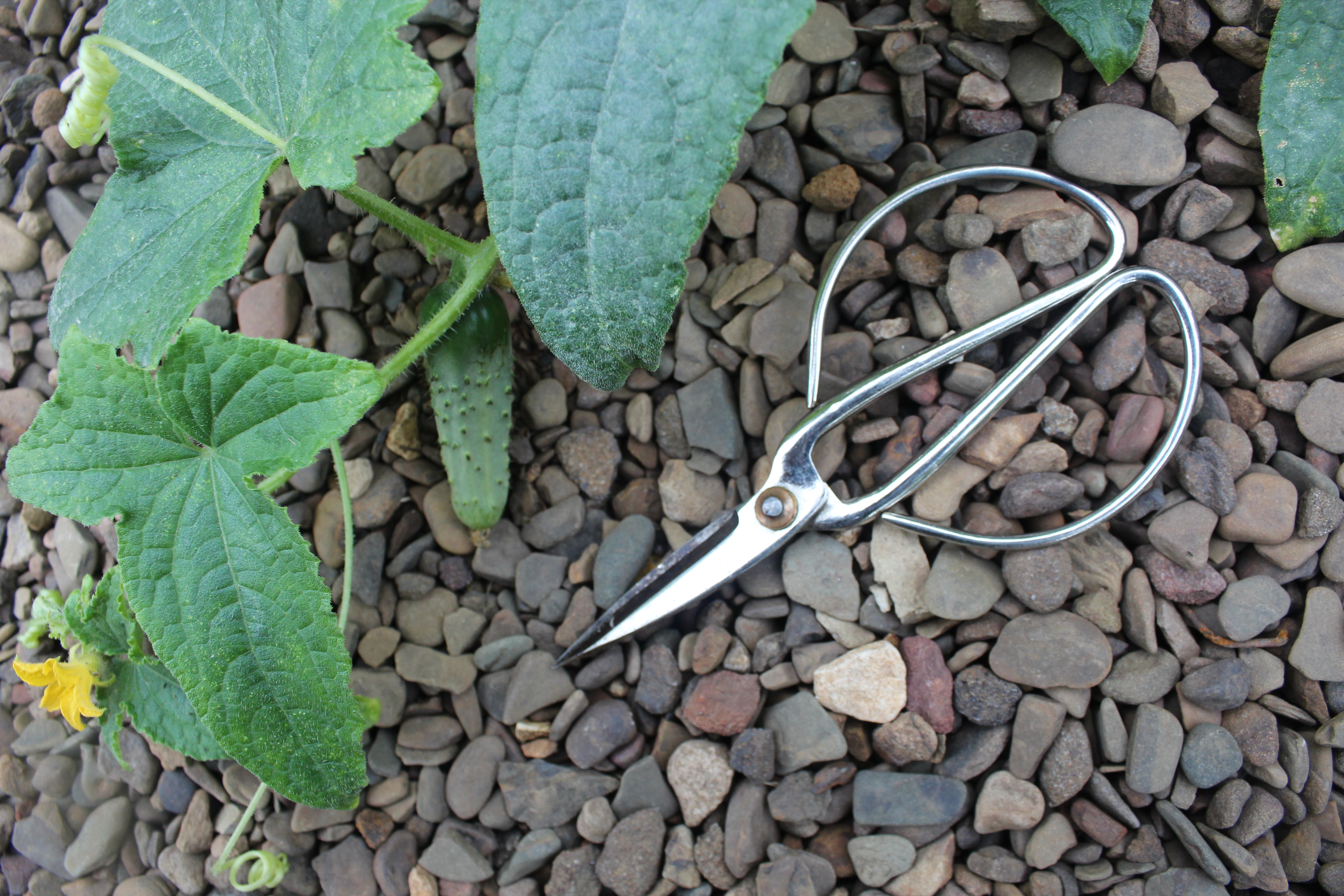
When it’s time to harvest peas, I’ll start from the bottom up, since that’s how they mature. It’s important to keep up with them because they can start to lose their sweetness quickly, plus harvesting speeds up production. I’ll use my trusty harvesting scissors to avoid damaging the delicate vines, and I’ll get definitely get my niece in on the action.

IMG_3176

SPRING PLANTING

St. Patrick’s day or not, Tuesday, March 17th was a big day in our garden. David and I both had the day off, it was warm and sunny with rain scheduled for the next day, and the soil was finally workable.

Do you know this term, workable? Many early seed packets will tell you to plant them “as soon as the soil can be worked.” This means that the ground is not frozen, and that it’s not too wet. Timing is tricky in the spring because you want to get stuff in the ground, but if you mess with your soil when it’s too wet you can seriously damage the soil’s fragile structure, causing it to clump and compact, something that is not easy to fix. Structure refers to the way soil hangs together, the relationship between the particles of soil and the pore space between them.  This relationship is crucial to your soil’s ability to hold moisture and air, for roots to grow through it, and for the millions of creatures living in it. Structure is different than texture which refers to the relative amounts of different sized mineral particles present in your soil (sand, silt, or clay). 

Soil is amazingly complicated stuff and is worthy of our deepest respect, but let’s not get into that right now. Suffice it to say that the timing was right and Tuesday was the day.

Incidentally, the best way to improve your soil’s structure is to add organic matter which also feeds your plants and enhances your soil’s capacity to hold moisture.  This is a task that is best done in the fall (because of those spring timing issues), but we didn’t get to it last fall, so we did it Tuesday.  Better late than never.

As a conflicted American consumer, I can find a million things to feel guilty about. When I lived on the East Coast in an apartment with an outdoor space, but no dirt, and no compost situation I never got used to not composting. For seven years, every time, seriously, every time, I threw food in the trash it bothered me. So one of the first things I did at my new place was establish a compost situation. It’s a pretty simple set-up, but I sleep better for it.

IMG_7075

The enclosed middle compartment is this season’s working compost. That’s where I put kitchen scraps, yard waste, leaves, judicious amounts of ashes from the fireplace, etc. The left side has wire around it that you can’t really see, I put leaves in there (I should add more to it), the other side is where last year’s compost got turned so I could start a new batch in the middle. I’m not a master composter yet, but I aspire to be, and I actually made a batch of compost last year, which feels like a major step on the road to a self-sufficient closed-loop garden. We weren’t sure if it would be enough to add some to all of our beds though, so David got a scoop from Nitron (www.gardeniq.com) to supplement.

IMG_7076

Then, while I was planting carrots and radishes, David, Mountain Man that he is, did the heavy lifting and wheelbarrowed compost into all the beds. Then he mixed it in and we were ready to plant!

CARROTS and RADISHES

IMG_3165

I started with carrots and radishes because that bed was already prepared from when I planted garlic in it in November. At that time I added compost and worked it in and made sure that the soil was nice and friable. Carrots like loose soil, which makes sense if you’ve ever seen a crazy knobby two-legged carrot come out of hard rocky soil. I have nothing against those carrots, I love the way they are physical embodiments of the journeys they’ve taken, but I still made sure my soil was loose and light as far down as a carrot might grow. Then I made a shallow furrow across the bed.

Carrot seeds are tiny and it always seems like the wind starts blowing right when you want to plant them. (To avoid frustration, it’s also a good idea to open your seed packets indoors when your hands are clean and dry.)

IMG_7094

I sprinkled them as sparingly as possible down the furrow. Because they’re so light, it’s hard to plant them thinly. One of the tricks of growing good carrots is thinning them. I’m happy that anything wants to grow in my garden, so it can feel ungrateful to pluck out tiny seedlings just as they’ve seen their first light, very Sophie’s Choice. But if you want nice carrots, that’s the sacrifice, so when these puppies get 1-2” high I’ll snip some off at the soil line. Then later I’ll try to thin them so they’ve got space around them about the size of a mature carrot with a little room to spare, hopefully I can eat those tiny thinnings.

I spent a lot of time trying to decide which carrots to plant this year. I finally narrowed it down to three: St. Valery, an ancient orange carrot with very high reviews for taste, Amarillo, a neon yellow carrot with a reportedly sweet taste, and Purple Dragon, a spicy, purple carrot with a deep yellow core. Then Baker Creek sent me some free Parisienne carrot seeds, which I had been curious about, so I’m trying them too. They are little round carrots, which makes them a good choice for less than perfect soils. It sounds like Baker Creek sent them free to everyone, and made them a lot of fans. I look forward to roasting them whole.

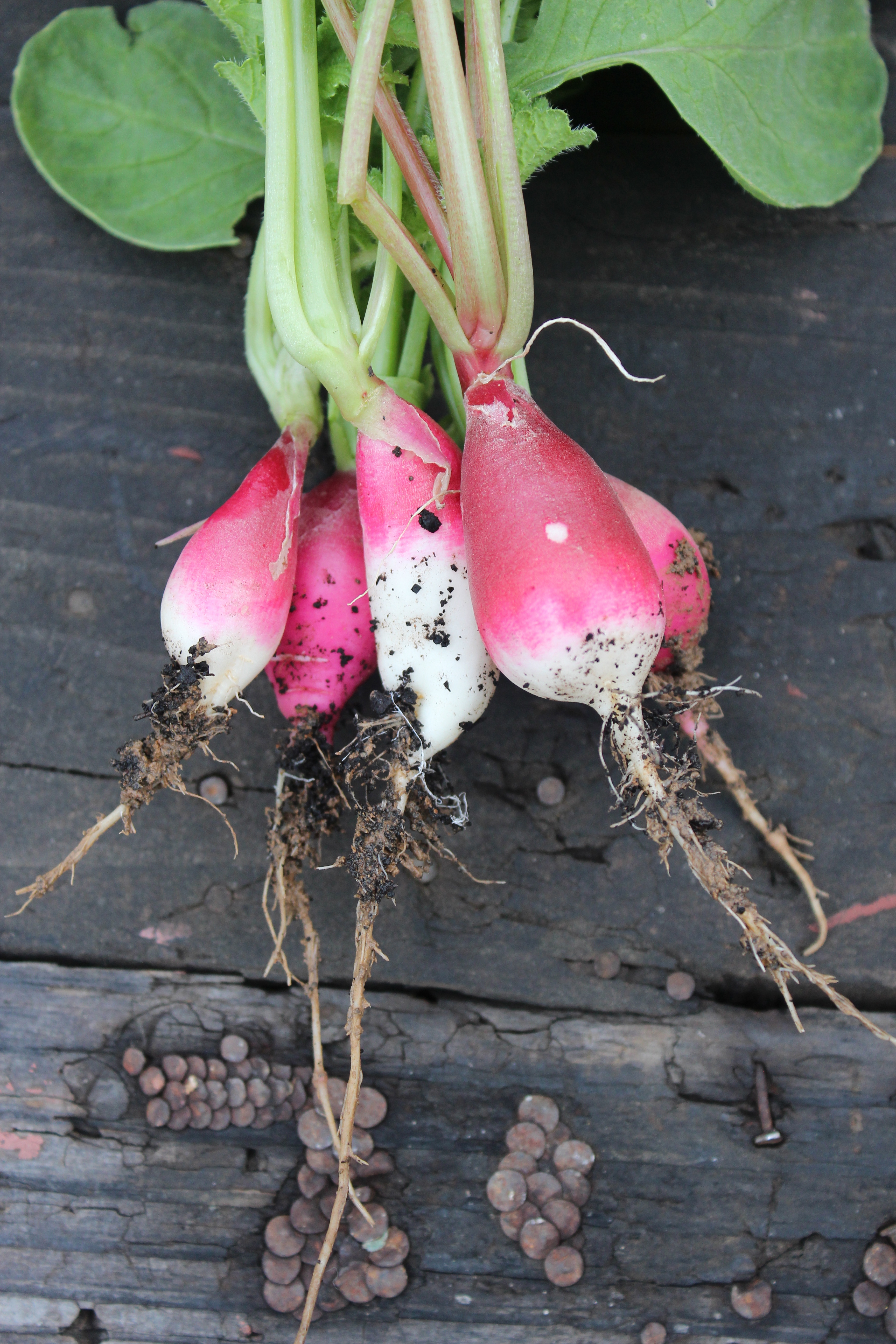
Carrots take a while to germinate and because I have a small garden, I’m always looking for ways to save room, so I like to plant radishes with my carrots. Radishes are quick. Once they germinate they provide shade for the slow spindly carrot seedlings. They also break up the soil for the carrots and are long gone before the carrots even get going. 

Radish seeds are bigger and easier to control. I placed them about 2” apart, then I carefully knocked a very light layer of soil over them and patted that down gently. I watered them with a watering can and then covered them with strips of burlap and watered those too. When the radishes germinate in a few days I’ll take off the strips and let the radish seedlings nurse the carrots along, keeping them all moist until it’s time to eat radishes! I’ll probably try to find room for some more carrots elsewhere and plant those in a month or so.  And once I’ve eaten the ones I just planted, I may plant some more there. Successive planting is a great way to make sure you have a crop all season. 

IMG_7103

Below is the root bed on May 23rd last year. You can see the carrots peeking out from under the radishes in front. That’s chervil in the very back of the bed with bigger leaved parsnips in front of it. In the bed behind are onions. Chervil is a great spring herb and I need to get some planted for this year! It’s a lovely, delicate, cool-weather herb, like a feathery parsley with hints of tarragon.

IMG_4747

IMG_7095

Wilson loves carrots. I told him it would take a while, I hope he’s not waiting for them.

FAVA BEANS

Remember these guys? Here they are March 11th, eight days after being planted.

IMG_7025

Inquisitive little things, aren’t they? Like little Loch Ness Monsters. Each checking out the situation in their own way. “Hi, have you gotten the schedule yet? What’s next?”

IMG_7022

And busy! We went away for the weekend and came back to these rowdy teen-agers. 100% germination!

IMG_7107

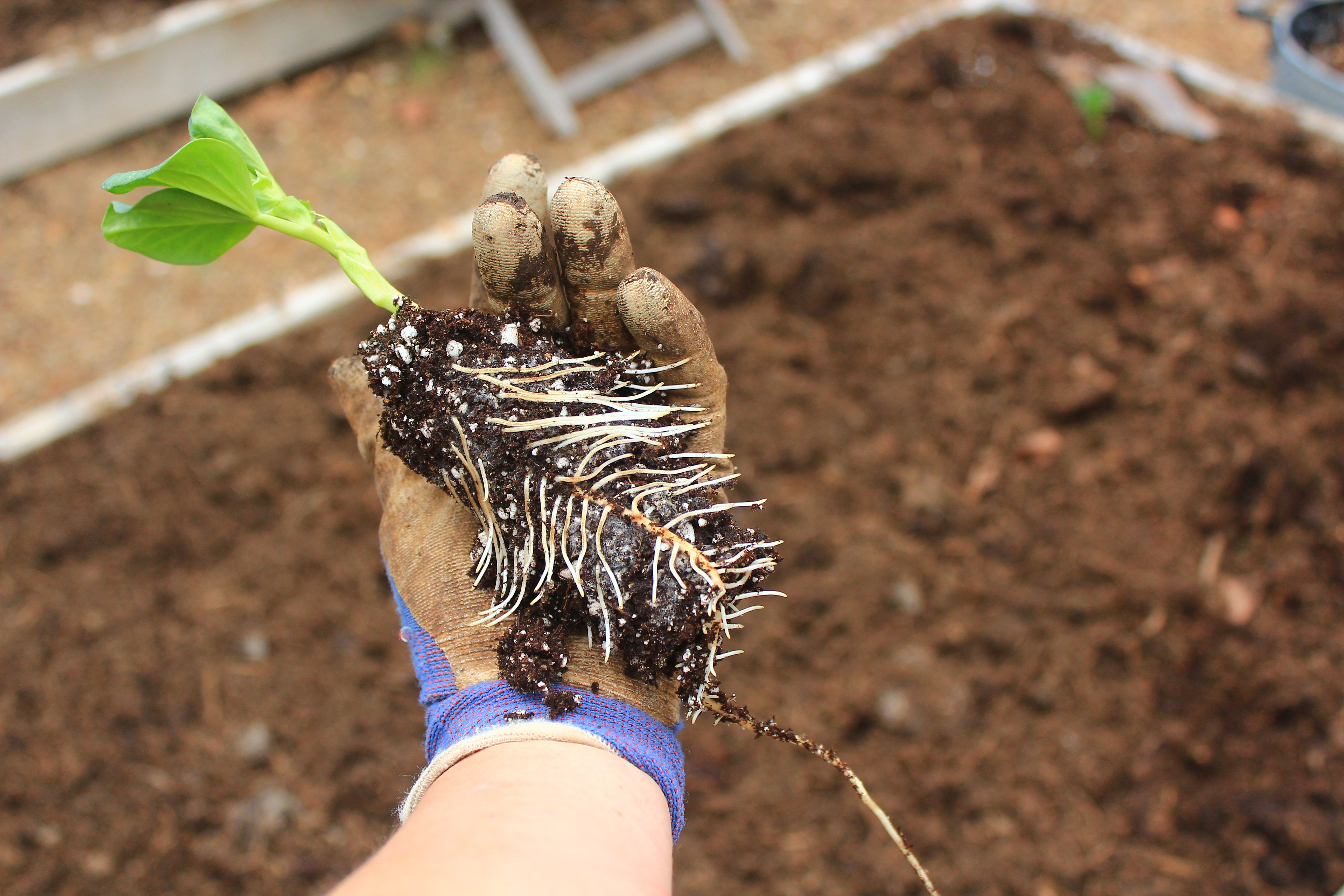
They got caught in the rain earlier in the week and were wetter than I wanted them to be, plus they were starting to get a little moldy. David took one out to examine it and saw that they had crazy tap roots, so we decided we’d better get those kids in the ground!

Their root systems really are amazing. Look at this action! Exquisite!

IMG_7112

And yes, I realize the whole point of the loo rolls was to leave them in place and not disturb that elaborate ladder of a root system, but then I read in Barbara Damrosch’s indispensable The Garden Primer (1988), that she had noticed when she pulled up spent crops in the fall that often the peat pots they were planted in were still quite intact. Ultimately, I decided to carefully remove the loo rolls (I put them in the compost) and plant them gently in deep holes. Luckily they got nicely rained in and so far they look really happy.

On to the next!