I am writing about growing cauliflower successfully today, because this might be the only chance I get!

This refined variation of Brassica oleracea (var. botrytris) is notoriously hard to grow because of its strict requirements for consistently cool moist weather and because as a member of the brassica family it is manna for every bug that plagues a garden. Okay, maybe not every bug, but some really determined ones.
Spring this year in Fayetteville has been exceptionally cool and while it’s not quite true, it feels like it has rained every day for weeks. In fact, it’s raining right now! I can’t remember a spring like this. If this is what it takes to grow cauliflower successfully I’d better take note.
To give you an idea the hurricane vase in the picture above is all rainwater. It’s even more full now.
You might be surprised to learn that cauliflower, broccoli, Brussels sprouts, collard greens, kale, kohlrabi, and heading cabbages are all variations on the same plant – Brassica oleracea – a weedy biennial that originated in Europe and Northern Africa. Each cultivar was developed by emphasizing a different part of the plant. Kale and collards emphasize the leaves. In cabbages, the terminal bud was exploited. With Brussels sprouts, it’s the axillary, or lateral buds that were tweaked. And with cauliflower and her kin broccoli, it’s the flowers, or inflorescences that early breeders concentrated on. That head of cauliflower is actually a mass of flower buds stopped in development before bloom.
Like its fellow members of the brassica family, cauliflower is incredibly good for you. It’s high in Vitamin C, Vitamin K, and fiber- which is important as it binds with cholesterol to sweep extra fat out of the body. It also contains protein, thiamin, riboflavin, niacin, magnesium, phosphorus, folate, potassium and manganese. It’s a good source of choline which plays important roles in brain development and memory, including protection from age-related memory decline (note to self: remember to eat more cauliflower). Additionally, sulfur compounds in cauliflower have been shown to kill cancer stem cells, improve blood pressure, and maintain healthy kidney function. They are full of antioxidants, phytonutrients, and glucosinolates – which keep the immune system from over-reacting. When our immune systems get too wound up too often it can result in chronic inflammation that’s linked to heart disease and cancer.
They are also really versatile in the kitchen. Raw, they’re an elegant crudite, or – I can’t wait to try this – finely ground in a food-processor they become a kind of rice or couscous which can be eaten raw in a tabouli-like salad, cooked with broth risotto-style, or frozen until you think of the perfect application (http://www.thekitchn.com/how-to-make-cauliflower-rice-couscous-cooking-lessons-from-the-kitchn-203344). They lend themselves beautifully to roasting, stir-frying, and pickling. They also add low-calorie, nutrient-rich, creaminess to purèes and soups.
My first attempt to grow cauliflower was last year (2014). I started ‘Giant of Naples’ seeds indoors on March 3rd.
On March 31st, I began hardening them off outdoors.
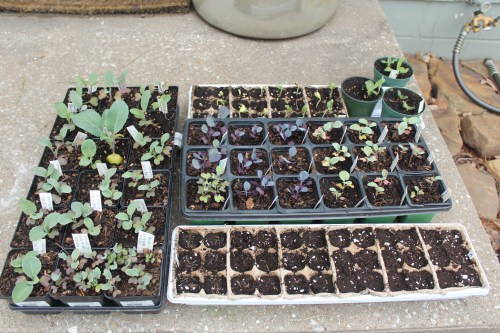
And on April 10th I planted them out in the garden.

Only then did I order a floating row cover from Johnny’s Seeds. (http://www.johnnyseeds.com)
When it arrived I covered them up to protect them from marauding insects.
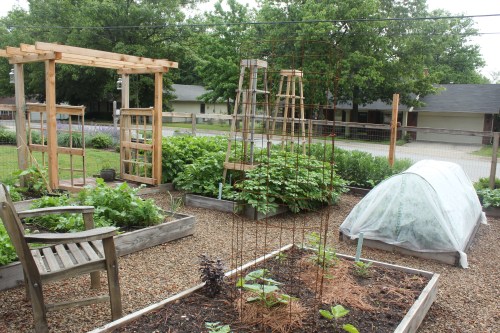
To no avail. Daily, I diligently lifted the veil and picked off the green catepillars (Pieris rapae) that are remarkably the exact same color as the cauliflower leaves. I had lots of gorgeous leaves for them to eat.

But absolutely no cauliflower. Not a curd. In fact the only glimpse of white I had was the fluttering cabbage moths who were laying the eggs that were becoming the worms that I was picking off. Very discouraging. In the windy picture above, the flower pot on the left side contains gaura ‘whirling butterflies’ – a perennial that I love. I had read somewhere that the moths were territorial and would think that space was already occupied by fluttering cabbage moths. No such luck.
Ultimately, my June 27th journal entry reads “I need to get the leaf bed cleaned out and just admit that cauliflower and broccoli was a bust. Will I try again? Probably.”
And…scene.
This year I entirely neglected to start cauliflower and broccoli seeds at all, but while I was buying my onion seedlings, I impulsively picked up an 8-pack of cauliflower seedlings labelled ‘Snow Queen’. (Although, I’ve found very little information about this variety online, and quite a lot that rings true about ‘Snow Crown’…) Regardless, nothing ventured…
I planted those out on March 17th and oh so proudly harvested five heads on Thursday, May 28th! In between, it rained and rained and rained some more. We built a PVC frame, but I never put on my floating row cover. And at some point – a little too late – I blanched them by tying the leaves up around the heads to keep them white.
The perfect cauliflower is a thing to behold, tight creamy white curds cradled in sturdy, elegant, leaves that seem to turn more blue as they age. Such refinement. They became very popular in France during King Louis XV’s reign as they were a favorite of his mistress, Jeanne Beçu Comtesse Du Barry. Like Parmentier and his potatoes, cauliflower is forever entangeled with the Comtess Du Barry, so if you see crème Du Barry on a menu, know you’re looking at cauliflower soup – and don’t lose your head.
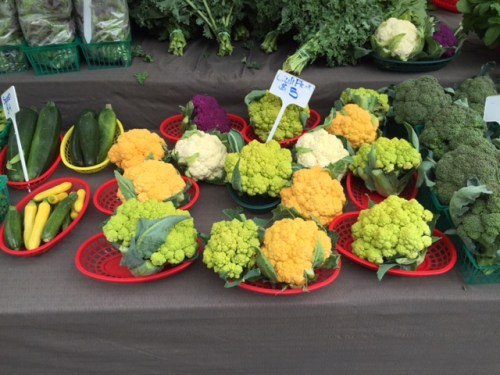
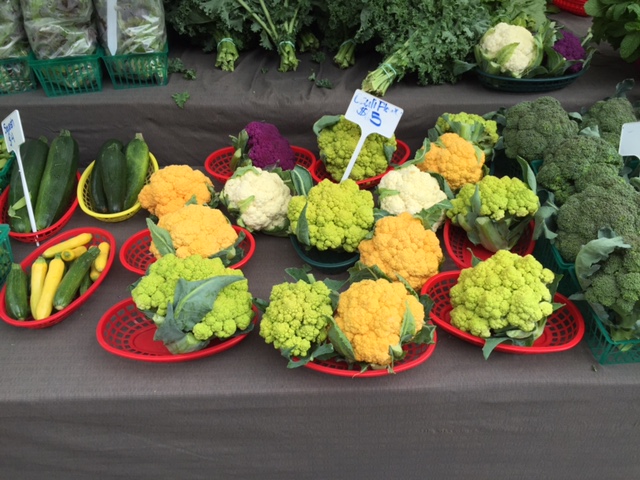
White cauliflowers are typical, but they also come in creamy orange, chartreuse, and a purple that doesn’t even look real. Check out this gorgeous spread from our farmer’s market. Those crazy green fractal ones are romanesco. My next challenge.
Here’s my crew. Perhaps not the finest specimens in all the land, but my mother’s love is blind. And while I know most of my success was Mother Nature’s, I’m still pretty pleased. Time will tell if I ever do it again.

I should have harvested them sooner, and not all at once. Ideally, you want tight, white, curds as the flower heads are called. They should be 6-8″. A couple of mine are larger and coarser than ideal and are tinged in purple. Purple heads are a result of sunlight activating anthocyanins which are pigments that occur in the tissues of all higher plants. They are what create the purple and red hues we see in autumn leaves.
But we ate them nonetheless!
Roasted cauliflower is a revelation. Olive oil and salt is all you really need. That and a 450º oven with a little tossing about now and again. Depending on the size of your florets they should be ready in about 30 minutes. Beyond that, they lend themselves to your endless culinary creativity. Fresh lemon juice and herbs? A creamy cheese sauce? A little fishy brine in the form of anchovy or fish sauce, and maybe some capers? You could go Asian with garlic and ginger. Or Indian aloo-gobi style with potatoes, peas, curry and turmeric. Mustard, parsley, mint, or dill all work nicely. Beans, polenta, or pasta will make it more substantial. And pork, pork always works.
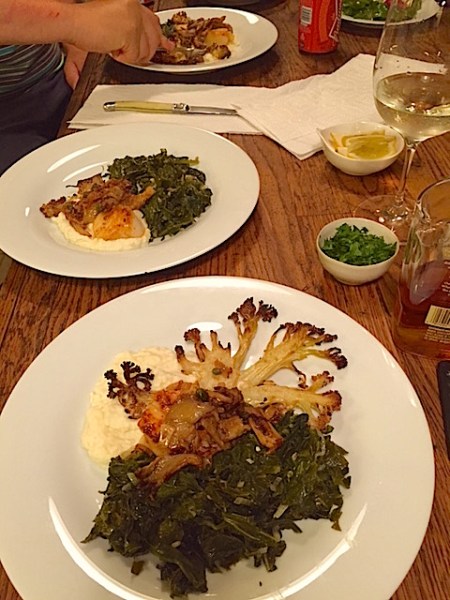
I had friends over for what I dubbed Cauli-palooza! ™ We had Cajun-spiced roasted cauliflower to start, a homegrown arugula salad with the first of the season roasted beets and goat cheese to break things up, and then seared sea scallops on creamy cauliflower puree with roasted cauliflower steaks, braised greens, and an oyster mushroom piccata sauce. Good stuff. And great company, but only passable photos.
An aside. When I worked at Elettaria in Manhattan, our strange and brilliant wine-guy, John, had this wine-education kit. Le Nez de Vin. It was from a company called Wine Aromas (http://www.winearomas.com). They provide educational tools that develop your sense of smell and enhance your enjoyment of wine. The kit we had was Les Defaults. The defaults. It contained twelve little vials. These were full of molecules directly linked to the twelve most common faults in wine. We all sat around and smelled these little vials and talked about wine. Pretty cool. Until we got to number nine. Number nine was cauliflower. The second I smelled it, I gagged. It made me angry. Like when someone accidentally hurts you and your first instinct is to hit them back. It was awful. Worse than vegetal, rotten apple, vinegar, glue, soap, sulfur, rotten egg, onion, horse, moldy earth, or cork. I held that against cauliflower for a while. But we’re really good now.
In cauliflower’s defense, the stench results when those, oh so good for you, sulfur compounds are released. That’s why it’s not a great idea to boil cauliflower for very long. Maybe a quick blanch before another method. Because, not only does overcooked cauliflower smell bad, it becomes less good for you. And there are so many healthier, less smelly ways to do it.
On the tails of my success, I’m going to try growing some more for fall. Based on an October 20th first frost date, Clyde is advising me to start seeds inside on June 21st, plant them out by July 26th, to begin harvesting in October. I’m skeptical. Summer is so hot. I don’t see how they could stand it. But I have some seeds for ‘Amazing’ cauliflower from John Scheepers, about which his catalog reads,
“Aptly named for its unique attributes, it is amazingly adaptable throughout the U.S. Both high-heat and freezing-cold tolerant, Amazing has uniform, bright-white, deep dome, 10” heads that are…self-wrapping! Hooray! Its productive sturdy plants have large, dense curds with tight florets just bursting with flavor. (OP.)”
Nothing ventured…
















 The Cultivator